
01 Sep Navigating Turbulence: How New Tariffs Are Redifining Global Supply Chains
Navigating Turbulence: How New Tariffs Are Redifining Global Supply Chains
As of March 27, 2025, significant tariff developments are reshaping global trade, requiring immediate strategic responses from businesses to ensure supply chain resilience and operational stability.
- Auto Industry Tariffs
Implementation Date: President Trump announced a 25% tariff on imported vehicles and foreign-made auto parts, effective no later than May 3, 2025.
Impact: Vehicle prices could increase between $3,000 and $6,000, with daily vehicle production potentially dropping by 30% or about 20,000 units. Major automaker stocks experienced sharp declines in after-hours trading.
- Tariffs and U.S.-China Relations
China Tariffs: A 20% tariff on Chinese imports remains in effect. However, President Trump indicated openness to reducing these tariffs to facilitate TikTok’s sale to a non-Chinese buyer, potentially signaling a shift in trade relations. The TikTok deal could also affect broader U.S.-China economic negotiations.
China’s Response: China has retaliated by imposing tariffs (effective March 10, 2025), including 15% on chicken, wheat, corn, and cotton, and 10% on sorghum, soybeans, pork, beef, and dairy products, significantly impacting U.S. agriculture.
- North American Tariff Responses
Mexico: Mexico is preparing retaliatory tariffs against U.S. goods; specific details will be announced soon. President Claudia Sheinbaum stated that Mexico seeks collaborative solutions and emphasized the importance of safeguarding national economic interests.
Canada: Canada announced plans for retaliatory tariffs totaling approximately C$155 billion. Prime Minister Mark Carney emphasized significant disruptions expected in the integrated North American automotive supply chain.
- European Union Reaction
The EU is formulating retaliatory measures on up to $28 billion of U.S. imports, focusing particularly on automotive and industrial products. Germany and France advocate for strong counteractions, warning of potential trade escalation.
- Sector-Specific Impacts
Automotive: Costs are rising significantly, disrupting North American production and supply chains. The United Auto Workers union welcomed the tariffs, anticipating domestic job creation.
Agriculture: Tariff-related input cost increases and market access reductions threaten U.S. agricultural exports, particularly soybeans and pork.
Pharmaceuticals: Potential 20% tariffs on EU pharmaceuticals could significantly increase drug manufacturing costs, impacting affordability and innovation.
Steel & Aluminum: A global 25% tariff is driving higher costs in construction and heavy manufacturing, pushing companies toward alternative sourcing strategies.
The global trade landscape remains volatile. Vector Global Logistics is committed to providing timely insights and personalized strategies to maintain supply chain resilience. For tailored advice, contact our team directly—we’re here to guide you through these challenging times.
Due to the speed of tariff news, we will be updating this LinkedIn newsletter with the latest info.
Navegando en la Turbulencia: Cómo los Nuevos Aranceles Están Redefiniendo las Cadenas Globales de Suministro
A partir del 27 de marzo de 2025, importantes desarrollos en aranceles comerciales están redefiniendo el comercio global, obligando a las empresas a implementar respuestas estratégicas inmediatas para garantizar la resiliencia y estabilidad operativa de sus cadenas de suministro.
- Aranceles en la industria automotriz
Fecha de implementación: El presidente Trump anunció unos aranceles del 25% sobre vehículos importados y autopartes fabricadas en el extranjero, efectivo a más tardar el 3 de mayo de 2025.
Impacto: El precio de los vehículos podría aumentar entre 3,000 y 6,000 dólares, con una posible caída en la producción diaria de vehículos del 30%, equivalente a unas 20,000 unidades menos al día. Las acciones de los principales fabricantes automotrices sufrieron fuertes caídas tras el anuncio.
- Aranceles y relaciones EE.UU.-China
Aranceles a China: Permanecen en vigor los aranceles del 20% sobre las importaciones chinas. Sin embargo, el presidente Trump mostró disposición a reducir estos aranceles para facilitar la venta de TikTok a un comprador no chino, señalando un posible cambio en las relaciones comerciales entre EE.UU. y China. Este acuerdo podría influir también en negociaciones económicas más amplias.
Respuesta de China: China ha respondido imponiendo aranceles (efectivos desde el 10 de marzo de 2025) del 15% sobre pollo, trigo, maíz y algodón, y del 10% sobre sorgo, soja, carne de cerdo, carne de res y productos lácteos, impactando significativamente la agricultura estadounidense.
- Respuestas en Norteamérica
México: México prepara aranceles de represalia contra productos estadounidenses; los detalles específicos se anunciarán próximamente. La presidenta Claudia Sheinbaum calificó los aranceles como perjudiciales y busca soluciones colaborativas, manteniendo al mismo tiempo la defensa de los intereses nacionales.
Canadá: Canadá planea aranceles de represalia por aproximadamente 155 mil millones de dólares canadienses. El primer ministro Mark Carney describió la situación como “un ataque directo”, destacando las serias interrupciones en la cadena automotriz integrada de Norteamérica.
- Reacción de la Unión Europea
La UE está elaborando medidas de represalia sobre importaciones estadounidenses hasta por 28 mil millones de dólares, enfocándose especialmente en productos automotrices e industriales. Alemania y Francia abogan por contramedidas firmes, advirtiendo de una posible escalada comercial.
- Impactos específicos por sector
Automotriz: Aumento significativo en costos, afectando la producción y cadenas de suministro en Norteamérica. El sindicato United Auto Workers respaldó los aranceles anticipando la creación de empleos locales.
Agricultura: El aumento en costos de insumos relacionados con los aranceles y la reducción del acceso a mercados amenazan las exportaciones agrícolas estadounidenses, particularmente soja y cerdo.
Farmacéutico: Posibles aranceles del 20% sobre productos farmacéuticos europeos podrían incrementar considerablemente los costos de fabricación de medicamentos, afectando su accesibilidad e innovación.
Acero y aluminio: Unos aranceles globales del 25% incrementa costos en construcción y fabricación pesada, impulsando a las empresas hacia estrategias alternativas de abastecimiento.
El entorno comercial global sigue siendo volátil. Vector Global Logistics está comprometido a proporcionar información oportuna y estrategias personalizadas para mantener resilientes las cadenas de suministro. Para asesoramiento específico, contacte directamente a nuestro equipo: estamos aquí para guiarle en estos tiempos desafiantes.
Debido al ritmo acelerado de noticias sobre aranceles, estaremos actualizando esta newsletter en LinkedIn.
2. Celebrating One Year as a B Corp—Purpose, People, and Impact!
This March marks our first anniversary as a Certified B Corporation™ and coincides with B Corp Month, a global celebration of businesses committed to using their platform for good. At Vector Global Logistics, being a B Corp goes beyond certification—it’s an ongoing commitment to positively impacting our people, clients, communities, and planet.
Through special podcast episodes featuring insights from B Lab leaders and sustainability experts, engaging internal events like B Corp-themed training sessions, and even an entertaining round of B Corp Bingo, our team has reinforced core values of purpose and action. We were also honored to be featured on the B Lab U.S. & Canada blog alongside other inspiring B Corps, recognizing our collective efforts to drive meaningful change.
Thank you for being part of our journey toward purpose-driven logistics. We’re excited to continue to use business as a force for good.
Check out our feature on the B Lab U.S. & Canada blog to see how we’re living our values every day!

3. Calidad Certificada ISO: Vector Global Logistics México Renueva su Compromiso
Vector Global Logistics México ha obtenido nuevamente la certificación ISO 9001:2015, fortaleciendo así su compromiso con la calidad y la satisfacción del cliente.
Esta recertificación refleja el esfuerzo constante de la empresa por mantener los más altos estándares en gestión de calidad, optimizar sus operaciones y asegurar un servicio confiable, ágil y eficiente para sus clientes. La norma ISO 9001:2015, reconocida internacionalmente, respalda el enfoque de Vector Global Logistics en la mejora continua y la entrega de soluciones logísticas que superan expectativas.
“Esta recertificación es un logro significativo para todo nuestro equipo y refuerza nuestra promesa de ofrecer servicios de clase mundial. En Vector Global Logistics, la calidad no es solo un objetivo, es la cultura que impulsa cada decisión y cada acción que realizamos”, afirmó Sergio Cervantes, Director General de Vector Global Logistics México.
La norma ISO 9001:2015 no solo valida los procesos internos, sino que también destaca el firme compromiso con la satisfacción del cliente, la innovación constante y la adaptabilidad frente a un mercado global en permanente evolución. Con esta renovación, Vector Global Logistics México reafirma su posición como socio estratégico confiable para empresas que buscan soluciones logísticas eficaces y de alta calidad.
¡Te invitamos a celebrar este importante logro con nosotros en LinkedIn!
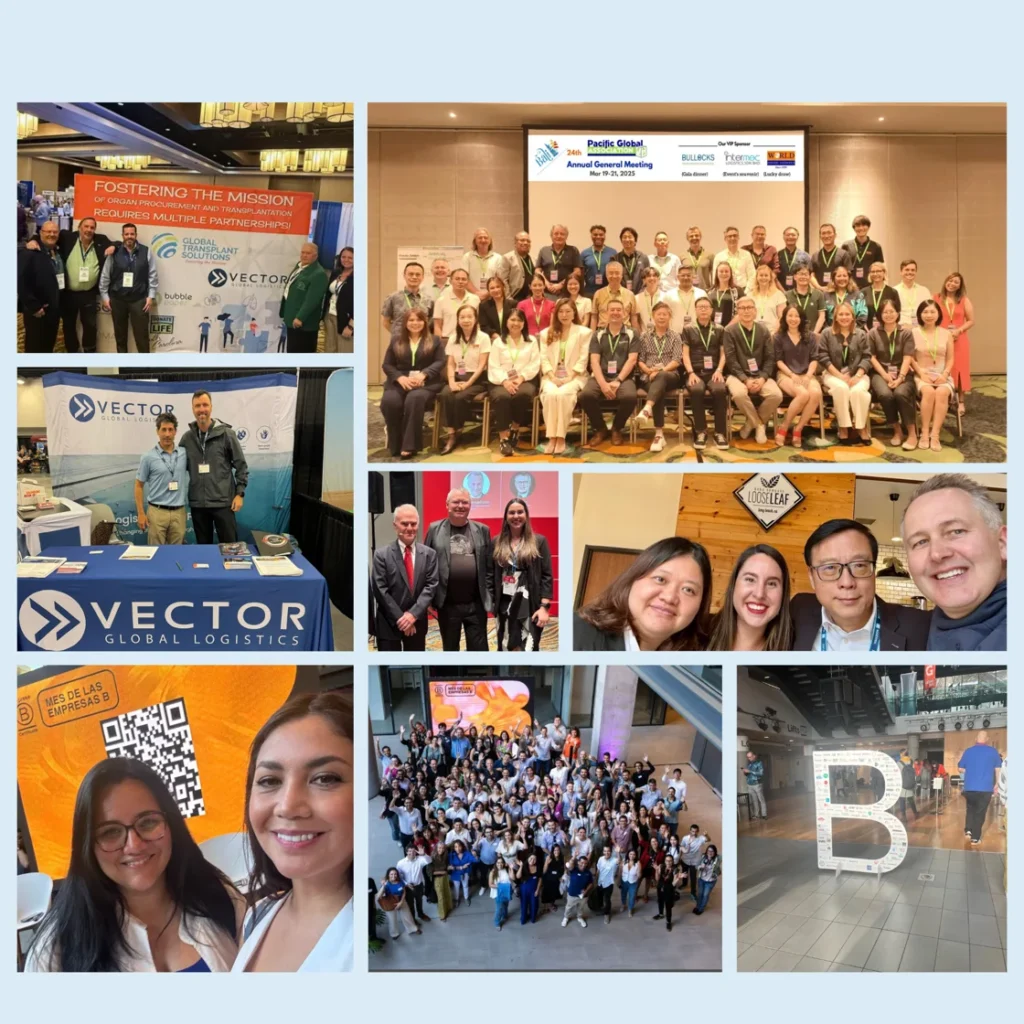
4. March in Motion: Vector Team on the Global Stage
This March, our team traveled across the globe to gain insights, build connections, and share expertise at prominent industry events. Here are a few highlights:
- Pacific Global Association AGM25 (Bali, Indonesia). Brian Oxley participated in a critical panel discussing the evolving U.S. tariff landscape. He underscored the necessity of agility, diversification, and strategic foresight in managing risks related to tariffs and potential retaliatory measures. Adaptability and continuous policy monitoring emerged as essential strategies for long-term business resilience.
- TPM25 (Long Beach, CA). Monica Roesch and Brian Oxley explored tariff impacts, port congestion, and the future role of AI and sustainability in logistics, emphasizing the need for strategic adaptation.
- Disasters Expo USA 2025 (Miami, FL). Enrique Alvarez and Clayton Schwarz showcased the importance of real-time supply chain visibility and advanced planning for effective disaster response and aid delivery.
- 50th Annual Meeting of NATCO (San Antonio, TX): Also, late February, Wade Stiles represented our team, highlighting our cold-chain transport expertise and emphasizing the critical importance of precise temperature control and specialized logistics in healthcare.
- Empresas B Chile Event: Kathe Mardones and Ruby Rodriguez from our Chile team attended this important gathering, connecting with fellow B Corps and exploring the new Mercado B platform designed to foster closer relationships within the B Corp community.
- B Local Georgia & PurposeFest (US & UK): Last but not least, Kristi Porter participated in B Local Georgia’s online event, gaining insights on community updates and engagement opportunities, and Nuria Sierra attended PurposeFest in Bristol, along with additional impactful events across London, furthering our commitment to purpose-driven business practices.
Vector Global Logistics remains dedicated to staying informed, proactive, and responsive to global shifts in trade, logistics, and disaster management.
Want to meet our team at future events? Check our Events Calendar to see where we’ll be next, or reach out directly to connect—we’d love to see you there!
5. How Should Firms Adjust to the EU’s Shift on Sustainability Reporting?
The European Commission’s proposed Omnibus Package introduces important changes intended to streamline sustainability regulations, but adapting could be challenging. Whether your company is based in the EU or operates internationally, these shifts will directly affect your ESG reporting strategy, demanding a renewed focus on truly material topics. Both EU and non-EU firms must prepare strategically to navigate the complexities ahead.
Stay ahead by exploring Boston Consulting Group’s insightful analysis in their latest newsletter, and dive deeper by accessing their comprehensive white paper on how businesses can best prepare for the EU Omnibus Package.



Catch up on recent episodes of our Logistics With Purpose® podcast: